
Councils and Committees
San Diego City College’s governance structure is designed to integrate institutional decision making into our core values. These core values are inclusion, equity, and social justice.
College Council serves as the highest level of governance at the college. It is composed of representatives from our students, faculty, classified professionals, supervisors, and administrators/managers. Five councils (Academic Senate, Classified Senate, and Associated Student Government) all report to College Council. Each of the five councils includes members from the college constituent groups and oversees specific areas of college activities. Councils may oversee additional reporting committees, workgroups, and task forces that support each council’s role.
The governance structure supports effective planning, decision making, and oversight that enables us to put our energies where they will produce the most value and impact for students.
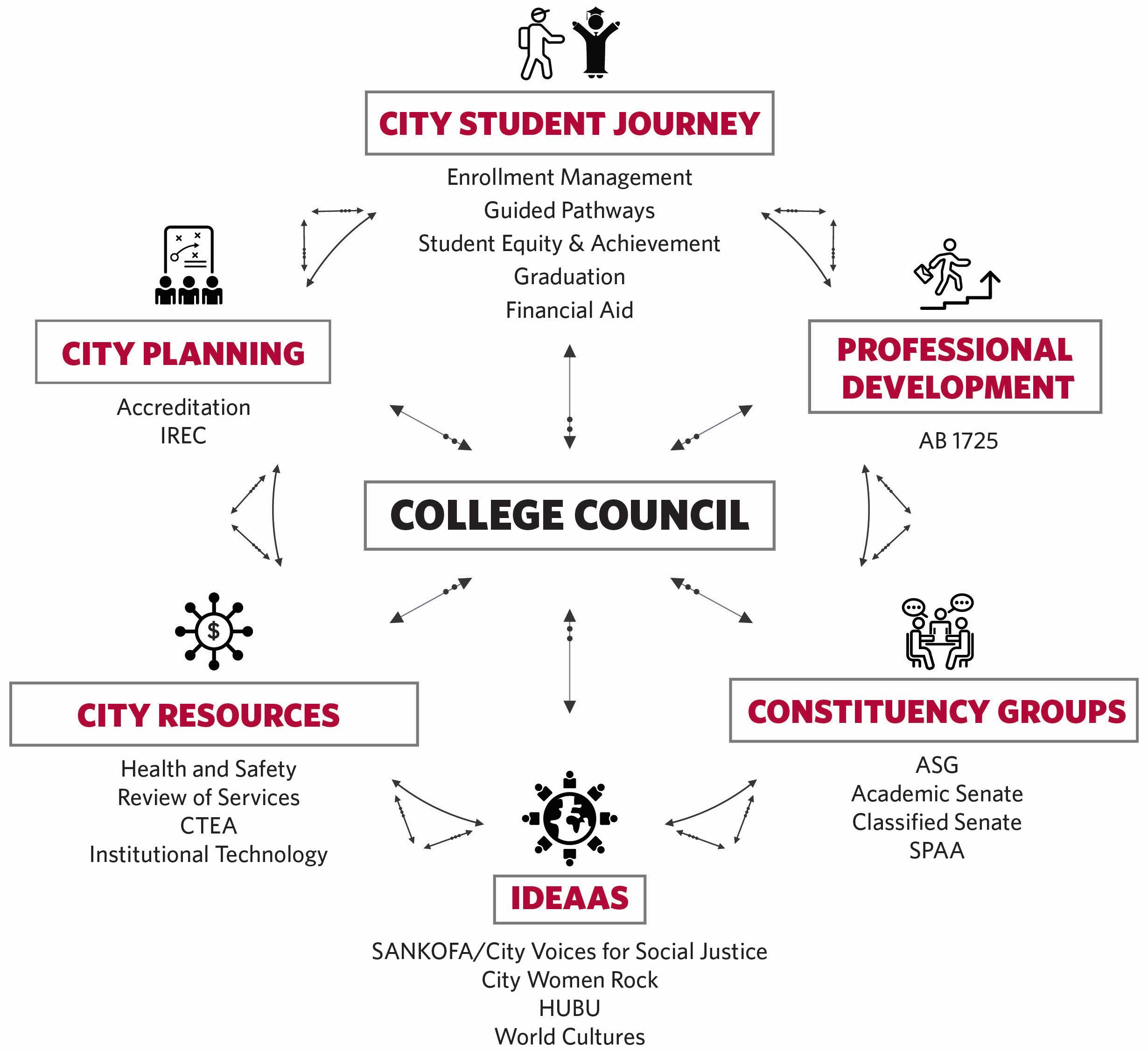
College Council meeting days and time: Every other Tuesday, 2:30 - 4:00 p.m., D-121
Agenda, Minutes and Related Administrative Activities
- Agendas and minutes shall be taken and disseminated.
- Minutes shall be posted in a public folder accessible electronically.
Charge and Decision-making Responsibilities
- Provides college-wide input on shared governance issues through review and discussion.
- Serves as the main policy body that forwards recommendations on shared governance issues to the district and Board of Trustees not requiring primary reliance or mutual agreement between the Academic Senate and the Board of Trustees or its designee.
- Assists in disseminating and interpreting policies and procedures to the appropriate constituent groups.
- Requests, considers, and makes recommendations to the College President on proposals from major decision-making groups (Instructional Services Council, Student Services Council, Master Planning, Assessment and Resource Oversight Council, Institutional Technology Council, Academic Senate, Classified Senate, Associated Students Government, Administrative Cabinet, Public Art on Campus).
- Oversees self-study and accreditation process.
- Coordinates the implementation of the Accreditation Team Report recommendations.
- Approves self-study report and planning agenda items.
- Organizes and tracks the flow of information between and among college decision-making groups.
- Facilitates communication and appropriate involvement of all members of the college community.
Operating Procedures
- Refers and/or redirects the issue or proposal to one or more Council, Standing Committee or Governance Group for appropriate research, discussion, debate, development, and recommendation to the College Council.
- Receives proposals or accepts identified issues from any individual or group within the college and;
- Forwards recommendations on shared governance issues not requiring primary reliance or mutual agreement between the Academic Senate and Board of Trustees. These recommendations are submitted to the College President and District Chancellor for action, or for presentation to the Board of Trustees for action.
- Establishes rules of order and other processes to be used by the College Council in the deliberation on college issues related to shared governance.
- Forwards any policy and procedural recommendation related to academic and professional matters requiring primary reliance or mutual agreement between the Academic Senate will be forwarded to the Academic Senate for review and approval.
- Tracks the work effort of the various governance groups.
- Organizes the flow of communication among and between groups.
- Reports on the status of issues before the governance groups.
- Coordinates the maintenance of the governance information system.
- Formulates appropriate recommendations for submission to the College President, where no additional information or participation is required.
- Determines that an issue is not within the scope of shared governance or is not appropriate for consideration by the College Council.
- Strives to achieve consensus on all issues before forwarding its recommendations
- Since consensus may not mean total agreement on every issue brought to the College Council, it is recognized that a minority opinion may be recorded.
Committee Members
Contact your representative to place items on the next agenda.
-
Ricky Shabazz - President
-
María José Zeledón Pérez - President, Academic Senate
-
Mona Alsoraimi - President Elect, Academic Senate
-
Matilda Chavez - Vice President, Instruction
-
Robbi Ewell - Chair, Institutional Technology Council
-
Cesar Gumapas - Public Information Officer
-
Marciano Perez Jr. - Vice President, Student Services
-
Susan Murray - Dean, Institutional Effectiveness and Co-Chair of City Planning
-
Jay Purnell - Supervisory Representative
-
Dometrives Armstrong - Administrative Representative
-
Soon-Ah Fadness - President, Chairs' Cabinet
-
Diego Bethea - President, Associated Students
-
Sean Ryan - President, Classified Senate
-
John Parker - Vice President, Administrative Services
Reporting Groups
- City Inclusion, Diversity, Equity, Anti-Racism, Accessibility, and Social Justice
(IDEAAS) Council
- SANKOFA/City Voices of Social Justice
- City Women Rock
- HUBU
- World Cultures
- City Planning
- City Professional Development Council
- AB 1725 Travel Committee
- Professional Development Advisory Committee (PDAC)
- City Resources
- Health and Safety
- Review of Services
- CTEA
- Institutional Technology
- City Student Journey
- Constituency Groups
- Academic Senate
- Associated Students Government
- Classified Senate
- Supervisory and Professional Administrators Association
- SANKOFA/City Voices of Social Justice
- City Women Rock
- HUBU
- World Cultures
- AB 1725 Travel Committee
- Professional Development Advisory Committee (PDAC)
- Health and Safety
- Review of Services
- CTEA
- Institutional Technology
- Academic Senate
- Associated Students Government
- Classified Senate
- Supervisory and Professional Administrators Association